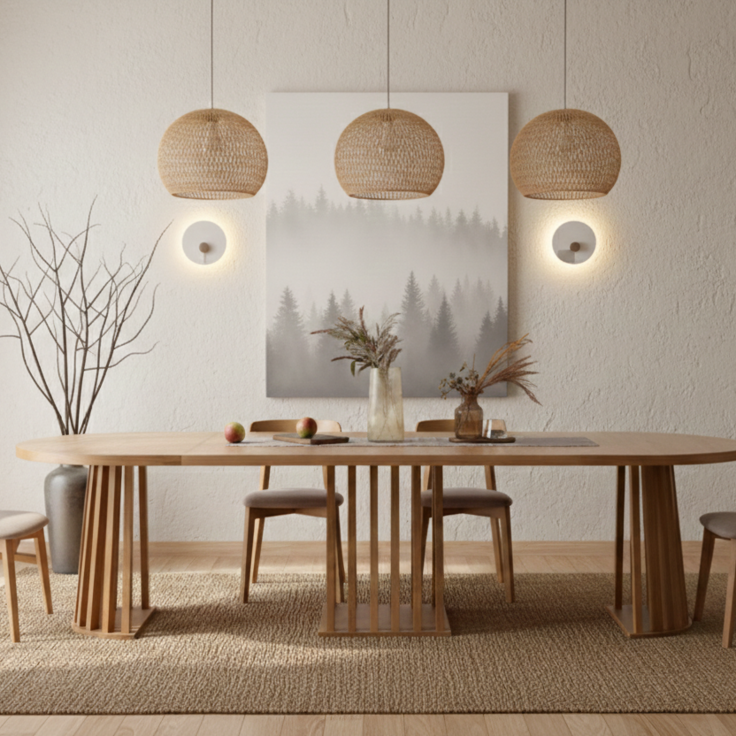
Wood – the heart of Japandi style
Natural wood plays a key role in Japandi style. Its authenticity, texture, and visible grain bring warmth and balance to the interior. Species such as oak, ash, and beech are particularly prized – durable, refined, and beautifully aged over time.
That's why solid wood furniture fits so naturally into this aesthetic.
Wooden tables in Japandi style – the center of home harmony
A table in Japandi design is more than just a piece of furniture – it's the focal point of the home. It should be solid, simple in form, and made of natural wood, preferably with a visible grain.
The ideal table in this style:
- has a minimalist shape, e.g. the EVRON table https://www.furnirest.pl/pl/produkt/evron
- exposes the natural grain, e.g. the MONTI table https://www.furnirest.pl/pl/produkt/monti
- is based on a stable but visually light construction, e.g. Tavo Oval https://www.furnirest.pl/pl/produkt/tavo-oval-2
- avoids unnecessary decorations, e.g. NORDIK STANDARD https://www.furnirest.pl/pl/produkt/nordic-standard
Solid oak wood perfectly captures the Japandi character – it's durable, elegant, and timeless. Its simple form highlights its natural beauty, eliminating the need for additional decoration.
Chairs – Ergonomics and Subtle Design
Japandi-style chairs should combine comfort with a subtle aesthetic. They often feature:
- slightly profiled backrests, e.g. COSMO https://www.furnirest.pl/pl/produkt/cosmo
- bent wooden elements e.g. TIGA I https://www.furnirest.pl/pl/produkt/tiga-i-2
- upholstered seats in natural, subdued fabrics, e.g. CASPE https://www.furnirest.pl/pl/produkt/caspe
- slender legs and balanced proportions e.g. DEFIhttps://www.furnirest.pl/pl/produkt/defi
Ergonomics and quality craftsmanship are important. A chair shouldn't dominate the space—rather, it should harmoniously complement the table and the rest of the interior. Wood in a natural color or in deeper, warmer tones perfectly captures the spirit of this aesthetic.
Coffee Tables – Lightness and Functionality
In a living room decorated in the Japandi style, a coffee table serves as a subtle yet important element of the design. The following models work best:
- with simple, geometric shapes like BELLA https://www.furnirest.pl/pl/produkt/bella
- made of solid wood or a combination of wood and metal like ORBEA II https://www.furnirest.pl/pl/produkt/orbea-ii
- with a low, calm line like FLORIS https://www.furnirest.pl/pl/produkt/foris
Round tops, turned legs, and minimalist metal bases combined with wood create an elegant contrast while maintaining a light visual feel. Functionality—for example, an additional shelf—should be discreet and subordinate to the overall form.